

OCRI Reveals the Biogeographic Patterns of Aflatoxin Production in Aspergillus flavus Populations and the Environmental Drivers of Fungal Evolution
On March 18, Nature Communications published online a major research achievement by the team led by Academician Li Peiwu at the Oil Crops Research Institute (OCRI), Chinese Academy of Agricultural Sciences (CAAS). The study systematically elucidates how environmental and evolutionary factors drive the phylogeographic differentiation and metabolic diversification of Aspergillus flavus populations, providing an important theoretical foundation for the prediction and precision management of mycotoxin contamination risks.
Aflatoxins are toxic secondary metabolites produced primarily by fungi such as Aspergillus flavus. They are highly carcinogenic and are associated with mutagenic, teratogenic, immunosuppressive, and hepatotoxic effects, with a well-established link to liver cancer. Aflatoxin contamination affects more than 110 food commodities and raw agricultural products, including peanuts, maize, and rice, posing a serious threat to food security and public health. In recent years, global climate change has expanded the geographic distribution of toxin-producing fungi and increased the risk of mycotoxin contamination. However, substantial differences in aflatoxin-producing capacity among A. flavus strains from different regions have long lacked a systematic explanation, limiting the accurate prediction and effective control of mycotoxin contamination.
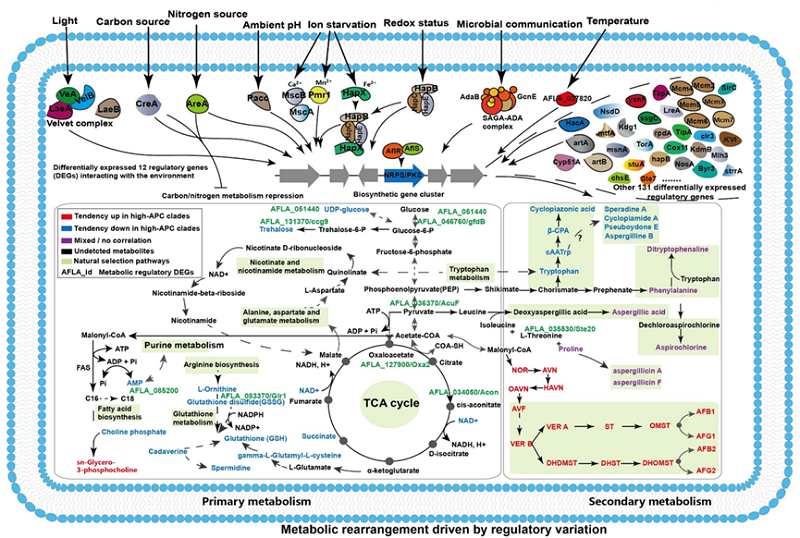
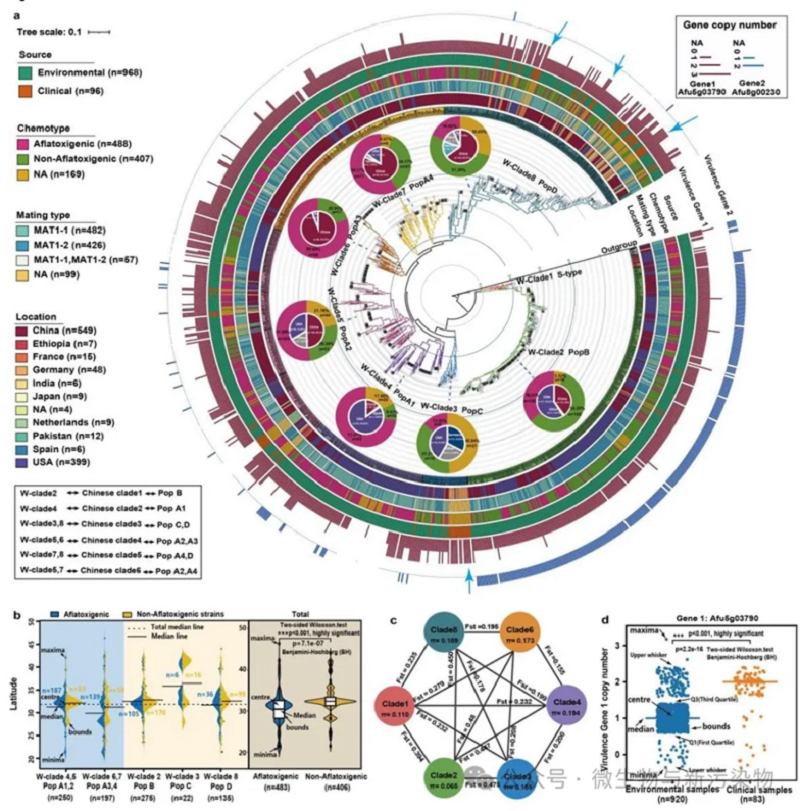
To address this challenge, the research team integrated a global collection of 1,052 A. flavus isolates from four continents and established the world's largest multi-omics dataset for this species. Comprehensive phylogenetic, genomic, metabolomic, and environmental association analyses were subsequently conducted. The study demonstrated that aflatoxin-producing capacity is closely associated with the genetic differentiation of A. flavus populations, which exhibit pronounced phylogeographic patterns. Highly toxigenic strains were found to be predominantly distributed in low-latitude regions characterized by high temperature and humidity. The researchers further revealed that variation in aflatoxin production is determined primarily by regulatory gene variation and the reprogramming of primary metabolic pathways, rather than differences in aflatoxin biosynthetic gene clusters. Environmental factors, including temperature, humidity, and soil properties, drive the evolution of metabolic phenotypes by selecting key regulatory pathways, thereby shaping the toxigenic potential of fungal populations. In addition, the study found that some low-aflatoxin-producing subpopulations are capable of producing other classes of mycotoxins, highlighting potential risks associated with conventional biocontrol strategies based solely on non-aflatoxigenic strains.
The findings advance current understanding of the environmental adaptation and metabolic evolution of fungi and challenge the conventional view that toxin production is determined primarily by biosynthetic gene clusters. The study provides critical theoretical support for the development of broadly applicable, region-specific precision control technologies for mycotoxins, including the ARC biocoupling technology, and offers valuable insights for safeguarding food security and food safety.